A founder called me a few weeks ago, out of breath and thoroughly confused.
Six months back, he did what every board member was screaming at him to do: he bought top-tier AI coding agents for every engineer on his team. Initially, the metrics looked staggering. PR volume spiked, line counts went through the roof, and the team was shipping raw syntax at a speed that felt almost illegal.
Then the hangover set in.
By month three, their main branch was constantly on fire. Staging had turned into a toxic landfill of half-baked features. PR reviews—once a quick 15-minute sanity check—had mutated into four-day forensics investigations where senior devs had to untangle 8,000-line diffs. The business leaders were furious (“We bought you the AI tools, why are features taking longer?”), and the engineering team was so burnt out they looked like they’d been fighting a war with a spork.
If you’re running an engineering organization right now, this horror story probably feels uncomfortably familiar. But here is the raw truth: your developers aren’t lazy, and your AI stack isn’t broken. You just hooked up a jet engine to a golf cart chassis and wondered why the axle snapped.
The Root Cause: High-Velocity Syntax, Zero Architectural Vision
Here’s what nobody tells you about autonomous agents: they are brilliant local writers, but catastrophic city planners.
Give an agent a single file, a defined utility, or a specific API endpoint, and it will give you remarkably clean TypeScript or Python in ten seconds flat. But agents don’t actually understand Domain-Driven Design (DDD). They don’t know the unwritten architectural rules of your business, and they certainly don’t care about module boundaries.
Left to their own devices across a complex codebase, agents solve immediate problems the only way they know how: by taking the path of least resistance. They leak domain logic, introduce subtle circular dependencies, bypass abstraction layers, and copy-paste boilerplate across six different directories just to make a local test pass.
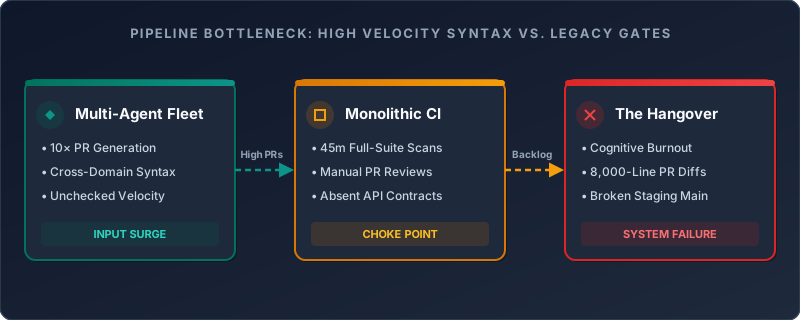
When one developer does this manually, a senior reviewer catches it in five minutes. When four autonomous agents are dumping thousands of lines of syntax into your git tree every afternoon, the architectural pollution scales exponentially.
Expecting a human reviewer to catch an implicit boundary violation across an 8,000-line AI diff isn’t code review—it’s torture. And it’s why your pipeline is completely choked.
How We Rebuild the Machine
To get out of this trap, you have to stop treating AI output like normal human code. You need to build a CI/CD pipeline that expects high-volume, boundary-pushing code generation, and automatically forces it into compliance before a human ever looks at it.
Here is how we restructure the system when I step into a company suffering from AI-induced pipeline paralysis.
1. Shift Boundaries to Contract-Driven CI Gates
A few years back, I watched a team waste three days trying to track down a silent production bug because an automated script slightly mutated a JSON payload structure that a downstream analytics service depended on. In an agentic environment, this happens ten times a day.
Humans shouldn’t spend their limited brainpower playing human compiler to catch schema mismatches. We fix this by putting hard consumer-driven contract testing (think Pact or strict OpenAPI enforcement) directly at the CI gate.
If an agent alters an API payload or breaks a cross-service boundary, the CI pipeline doesn’t just fail—it dumps the exact contract violation error back into the agent’s context loop. The agent self-corrects and fixes its own boundary violation in the background. By the time a human engineer gets notified for a PR review, the system structure is already proven to be safe. The human can focus entirely on high-level business logic, trade-offs, and maintainability.
2. Force Hard Bounded Contexts (Decouple the Monolith)
If you hand an AI agent the keys to a monolithic codebase where every module can talk to every other module, it will turn your system into spaghetti. It doesn’t mean to; it’s just trying to satisfy the prompt.
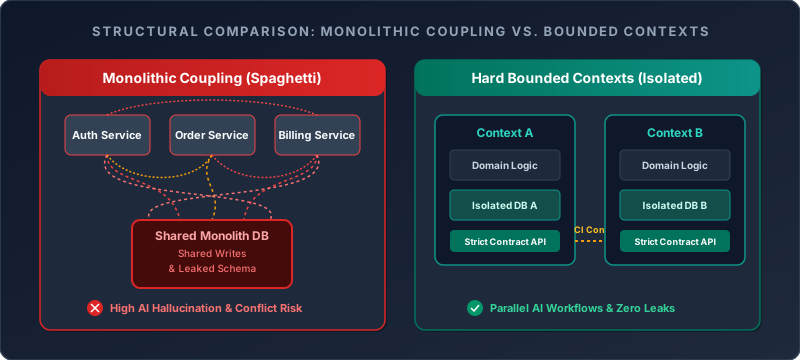
The solution is structural isolation. Whether you use monorepo tooling like Nx or Bazel, or break services into explicit micro-packages, you have to lock the agent inside a strict sandbox. When an agent is physically restricted to a single bounded context, it literally lacks the visibility to hallucinate tightly coupled logic across domain lines.
For your team, this is life-changing. It means two devs—running two different agent workflows in different parts of the app—can actually push code simultaneously without triggering a late-night, multi-file merge-conflict nightmare.
3. Rebuild the Inner Loop for Sub-10-Minute Feedback
Nothing kills engineering momentum quite like context switching. A dev prompts an agent, spins up a PR, triggers a build, and then sits there for 45 minutes while a bloated monolithic test suite runs. By the time the build fails on a typo in line 400, the dev has already moved on to something else, lost their flow state, and now has to mentally ramp back up.
Agents thrive on tight execution loops: Write → Execute → Read Error → Fix.
If your test suite takes nearly an hour to run, your agent feedback loop is broken. We optimize the inner loop by aggressive test parallelization and target-affected test runs. When a build fails in 90 seconds instead of 45 minutes, the agent can iterate and fix its own syntax mistakes in real-time. More importantly, developer wait times drop under 10 minutes, keeping your engineers focused, sane, and in the zone.
The Bottom Line
You cannot manage your way out of a broken architecture by yelling at your developers to “review PRs faster” or telling everyone to work harder.
When you scale code generation without updating the underlying pipes, you aren’t accelerating features—you’re just accelerating technical debt. The winners in this new era aren’t going to be the teams that blindly dump the most AI code into git; they’ll be the ones who built an architecture capable of digesting that velocity without exploding.
Ready to Unclog Your Engineering Pipeline?
If your team’s velocity has flatlined despite your AI investments, stop pushing harder on a jammed assembly line. You need an architectural reset.
Book a 48-Hour Engineering Diagnostic with Mile Zero Software. We’ll dive straight into your codebase, map where your pipeline is leaking velocity, and build a system designed to handle real scale.